

Goats are having a moment—especially baby goats, the newest TikTok celebs. One TikTok account, @goatdaddys, has more than four million followers for its videos of kids (the goat kind) doing the goofy things that they do. But it hasn’t always been thus. In the 19th century, goats in America were despised and deplored. They roamed San Francisco and New York City eating people’s hedges and outraging the gentry.
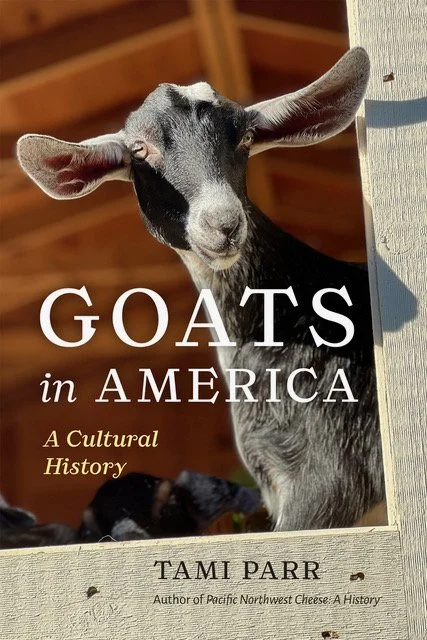
Today, goat cheese is a multibillion-dollar business in the U.S. and demand for goat milk far outstrips supply. How did this formerly low-class ruminant manage its makeover? I learned so much about goats, goat milk, goat cheese and American history in Tami Parr’s engaging new book, Goats in America: A Cultural History. I spoke to Parr recently via Zoom to dive deeper into some of the book’s content. Here’s our condensed conversation:
Goats have had a roller-coaster existence in this country—from being a public nuisance that needed eradicating to starring in the 1916 Rose Parade. When was the high point for the lowly goat?
There was such a moment in the early 20th century when America started to turn to goats as a savior of humanity. It was because of goat milk, which was perceived as free of bacteria, specifically tuberculosis bacteria. That was when goats broke away from all the negativity. But I would say we’re reaching another high point now, in terms of cute baby goats on social media.
And their lowest point?
There are negative associations in the Bible, but in terms of American history, the low point would have to be the 19th century, when cities were deluged with roaming animals. Industrialization was happening and there weren’t yet “farms over here and cities over there.” Irish, Italian and German immigrants were flooding the U.S. and cities were not prepared to house and feed them. That led to shantytowns, where immigrants kept chickens, pigs and goats to feed themselves, and it created a class of people that established residents didn’t like. One of these neighborhoods—Dutch Hill in New York City—is where the United Nations building is today.
You could argue that tuberculosis is the reason we have a goat cheese industry in the U.S. today.
One hundred percent.
Could you explain the connection?
In the mid 19th century, prior to our understanding of bacteria, cow’s milk started to be used for infant feeding. And infant mortality skyrocketed. About this time, scientists started to understand that cattle carry tuberculosis bacteria and the disease can be passed to humans through milk. Tuberculosis was an intractable epidemic for centuries. We know now that goat’s milk can also transmit tuberculosis, but at the time, the belief was that it was pure. By the 1920s, hundreds of goat milk dairies had sprouted.

Goat historian Tami Parr
So there was a market for the milk, but goat cheese lagged behind. You write that in 1978 there were only eight commercial producers. But by the mid 1980s, goat cheese was off to the races. Laura Chenel was in People magazine, and Ronald Reagan was serving California chèvre to Queen Elizabeth. At the time, it seemed like everyone was buying goats and making cheese. And now, forty years later, you write that “the era of small farmstead goat cheese production is over.” What happened?
It's the economics. The big industrial producers like Vermont Creamery, Laura Chenel and Saputo can make it a lot cheaper. A cheesemaker in Maine told me she goes to Walmart and sees the chubs (small logs) for five dollars and she can’t possibly make it that cheaply. Big producers are importing frozen curd, which makes it cheaper for them to produce fresh chèvre. It's not a new thing. Laura Chenel started importing frozen curd in the 1990s because her company couldn’t keep up. It’s a way to bridge the supply gap and keep your business going through the winter. As goat cheese production has gotten huge, dairies can’t produce enough milk, so companies are importing frozen curd to support production.
Is goat cheese truly a multibillion-dollar industry in the U.S.? Where is it all going?
There are no hard numbers because there is no organization collecting numbers, but I feel comfortable with “multibillion.” Consumption has gone off the charts. Goat cheese has exploded in popular culture; it’s on pizza and in beet salads. In the Laura Chenel/Chez Panisse days, goat cheese was “French” and gourmet and people aspired to that. Now it’s much more common.
So of course I have to ask, what are your favorite American goat cheeses—in any style?
River’s Edge Up in Smoke, always, on a whole-wheat cracker. Their milk is outstanding. Mountain Lodge Farm Tipsoo, which is washed in cider and lightly stinky. And Blakesville Creamery’s St. Germain. Everything I’ve tried of theirs has been outstanding.
