
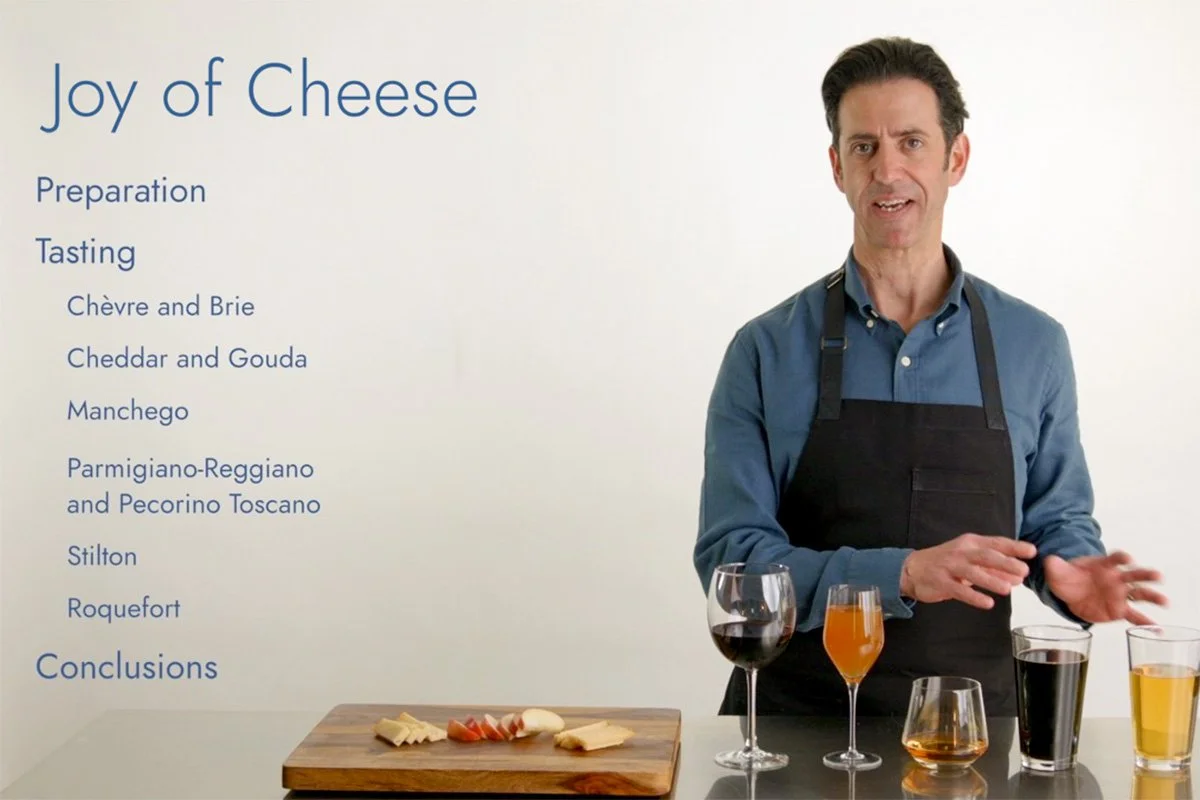
I’ve spent the past 25 years learning about cheese through reading, writing, traveling, teaching and tasting. According to the 10,000-Hour Rule, I should be an expert. But you don’t need to invest quite so much time if your mission is simply to know more (a lot more) about cheese a month from now than you do today. For that, I can recommend a terrific new online course that impressed me with its thoroughness and structured approach. If I sound like a paid pitchman, I’m not. But in my view, the course creator—who invested five years in its development—has produced an entertaining and worthwhile video curriculum suitable for everyone from novices to cheesemongers.
Jeremy Snyder left an academic job in renewable energy to focus full-time on his idea for an online cheese course. A longtime cheese enthusiast, Snyder still often felt lost at the cheese counter, intimidated by the choices. “I didn’t feel confident in buying the right one and serving it,” he recalls. “So I wanted to create a framework for myself to understand cheese.”
The result of his passion project is Joy of Cheese, a polished, well-thought-out online course with 28 self-paced lessons; five hours of lesson videos; gobs of images, graphics and animations to explain some of the science; videos of cheesemaking techniques; suggested tastings; and numerous links to other online material if you want to delve deeper. There’s a lot here to keep you busy.

Jeremy Snyder
Snyder narrates the videos in a clear and conversational manner. He’s not a performer; he’s a teacher. Cheese science is complex—there’s a lot of chemistry going on in that vat—but the course’s lively graphics and animations make it more comprehensible.
Snyder divides the universe of cheese into 10 families, giving you a solid foundation for understanding their differences. Spend enough time with this course and you’ll come away with more familiarity with basic cheesemaking, more confidence in your ability to taste and evaluate cheese, some science-based information on cheese and health and enough reference material to answer just about any cheesy question.
A few things I learned:
You can “uncoagulate” cheese. In a simple exercise to highlight how acid coagulates milk, Snyder shows how you can return some cheeses to a liquid state through chemistry, not with heat.
I’ve long wondered why cheesemakers don’t make large goat cheeses—say, the size of Gruyère or pecorino romano. I’ve never gotten a satisfying answer from a cheesemaker, but Snyder says it’s because the casein in goat’s milk yields a more fragile curd.
Ever heard of domiati? Me neither. It’s a feta-like Egyptian cheese made from water buffalo or cow’s milk. Unusually, the milk is salted before cheesemaking begins. I’m not aware of any other cheese made that way.
Compared to the cheese books in my home library, Snyder’s course offers the clearest explanation—especially if you’re a visual learner—of how milk becomes cheese. “I have talked to cheese professionals who've studied for the CCP exam and told me this course would have been helpful to have,” says Snyder.
The course is $100 and you can learn more at www.joydemy.com. What a great gift for someone interested in exploring this endlessly rich topic.
