
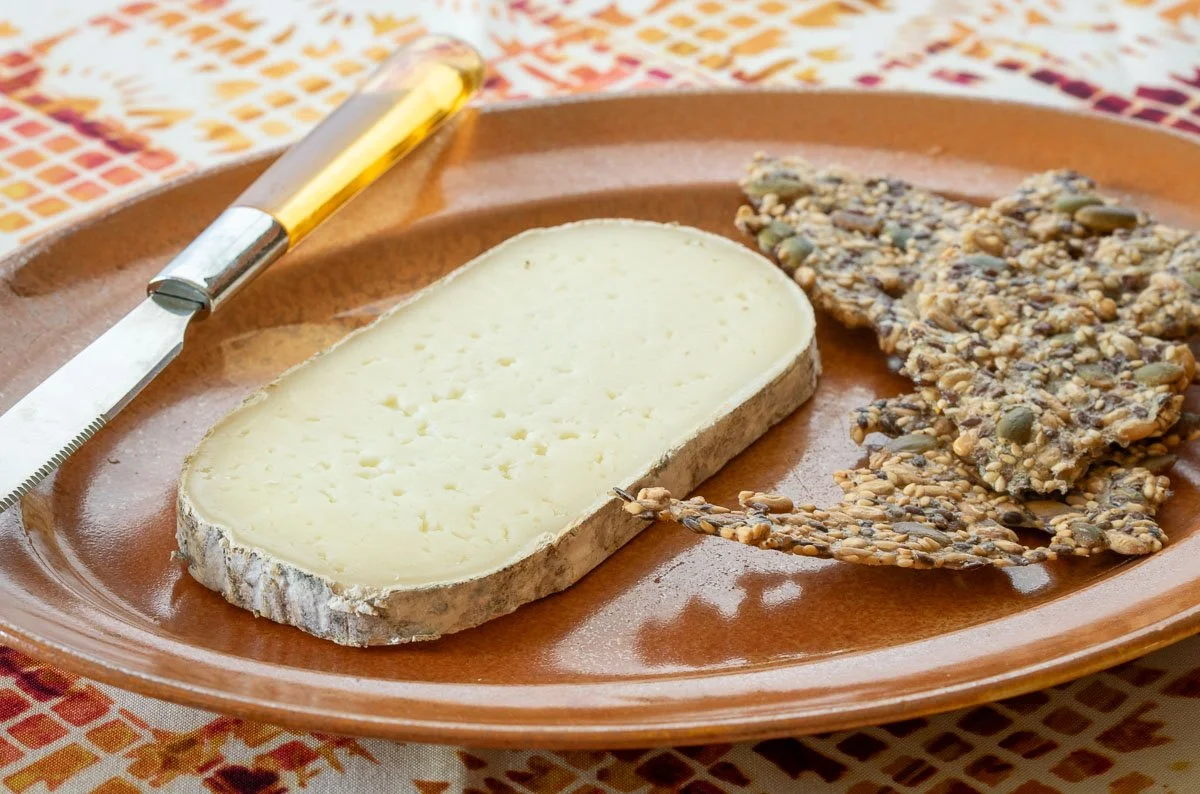
I went a little crazy at the cheese counter the other day and came home with more than I usually buy at one time. So, at the end of a simple dinner that night, Doug and I had an over-the-top cheese course. Miraculously, we had the same favorite. A new import from Spain, it had all the features I seek: captivating aroma, pleasing texture, proper salting. That it played well with the red wine on the table earned it some more points. I’m excited to introduce you to this unusual newcomer and try to build its U.S. fan club.
Years ago, when I was on the San Francisco Chronicle food staff, the food section had a young intern named Andy Lax. After his internship, Lax took a sales job with a new Northern California cheese distributor and helped that company, Fresca Italia, grow. Lax now lives in Madrid and Fresca Italia’s portfolio is slowly starting to include some of his Spanish finds. Pata de Mulo is one such discovery, matured in the cellars of Cultivo, a highly regarded Madrid cheese shop with affinage expertise.
Several creameries produce Pata de Mulo (“mule’s leg”), a traditional sheep cheese from the area around León. The one imported by Fresca Italia is from Praizal, a family farm and creamery. Pilar Blanco makes the cheese with her nephew; her brothers provide the raw sheep’s milk. They milk Assaf sheep, a prized Israeli breed that is becoming established in this region of Spain.
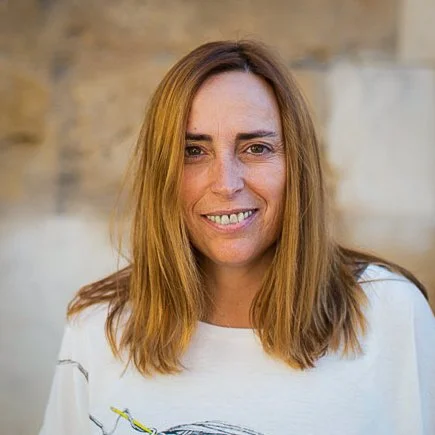
Sheep cheese whiz: Pilar Blanco
The cheese’s whimsical name refers to its shape—a flattened log weighing about 4 pounds. You’ve seen this format before. Patacabra, from goat’s milk, has the same peculiar shape, produced by gentle pressing. A thick slice is eye-catching on a cheese board.
Cultivo babysits the cheese for two to four months, and whatever they’re doing, I hope they keep doing it. The natural rind is thin and handsome, with a riot of multicolored molds. The pale ivory interior has small openings and a delicate mushroom and cave aroma. I love the texture—tender and creamy—and the subtle flavor of nuts and artichoke.
Oh, to live in Spain where this fabulous cheese costs about $12 a pound. Here you will likely pay closer to $40 a pound—a hefty tab but worth it to experience such expert craftsmanship.
Look for Pata de Mulo at these California retailers: Market Hall Foods (Oakland), Milkfarm (Los Angeles), Oliver’s (Santa Rosa area). Paradise Pantry (Ventura), Sunshine Foods (St. Helena) and V. Sattui (St. Helena).
And now for some bad news: We have lost another American artisan cheese producer and another independent cheese shop.
Keith Adams, proprietor of Alemar Cheese and Wm Cofield Cheesemakers, announced recently that he is ceasing operations. Adams launched Alemar Cheese in Minnesota in 2009 but moved production a couple of years ago to Sonoma County, California, where he was making Cheddar under the Wm Cofield brand. Alemar’s Bent River was a popular Camembert-style cheese, and I admired it, but his McKinley Cheddar never quite got traction.
Covid was the turning point, Adams told me. “The way I grew Alemar was demo-ing a lot, and with Covid there was no more demo-ing.” Even today, says Adams, Covid’s impact persists in “fewer mongers, less excitement about new things and a general gravitation toward cheeses that can be Cryovac’d.”
Equally troubling is the closure of DTLA Cheese, a much-admired Los Angeles merchant. In a tearful Instagram reel, proprietor Lydia Clarke and chef Reed Herrick said the 12-year-old shop’s last day is April 17. “We have reached the point where we have to close the doors,” they wrote in an accompanying post. They didn’t offer any specifics, but I can only imagine that in a city with high rents and labor costs, you have to sell a boatload of cheese to pay the bills.
