
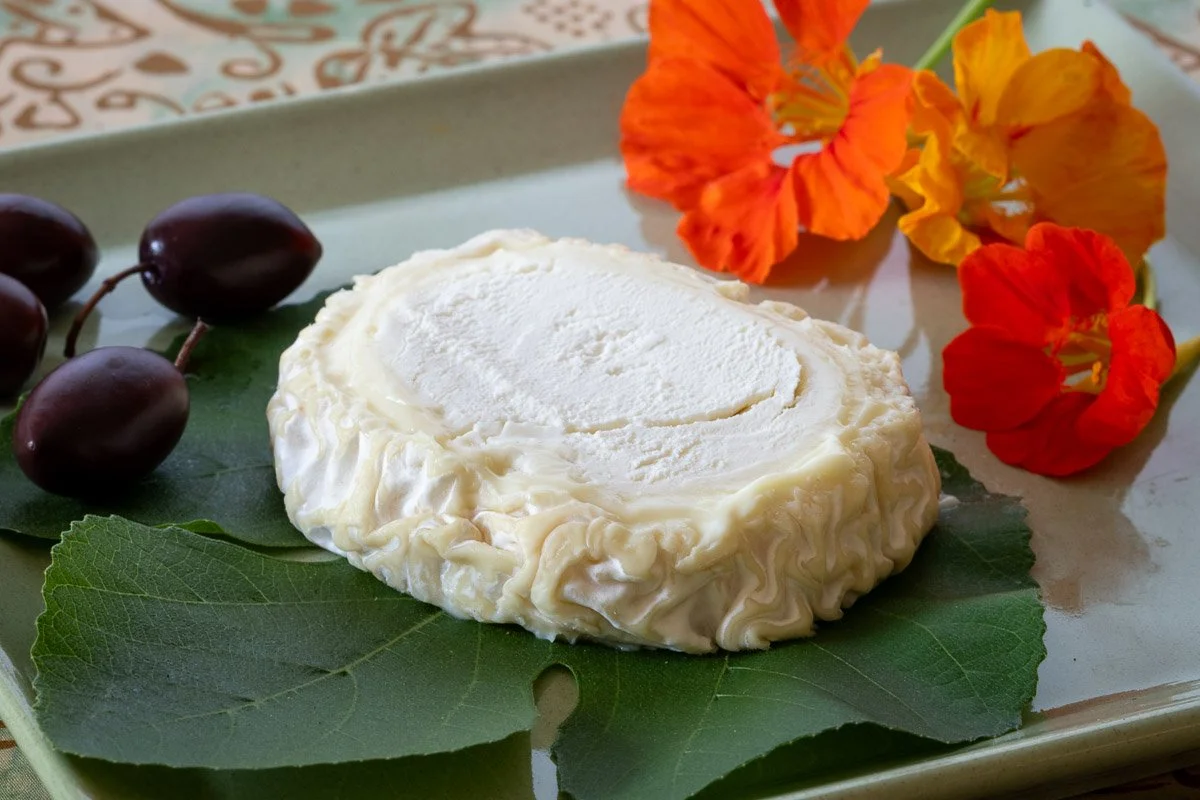
The notion that cheeses have seasons is less valid than it used to be, but springtime still says goat cheese to me. On small French farms run the traditional way, goats give birth in early spring. Once the kids are weaned, there’s abundant milk for cheese—for all those delicate fresh chèvres and, a few weeks later, lightly aged creations like the one pictured above. Breeding advances and sophisticated aging rooms have altered this pattern, but I still associate the warming weather with creamy, tangy goat cheese. And any day now, wineries will begin releasing their 2025 Sauvignon Blancs and rosés—the ideal chèvre companions. Add a baguette and a handful of olives and your cheese course is done.
La Fromagerie P. Jacquin, the 80-year-old creamery behind the lovely Bûche de Luçay (above), specializes in goat cheeses in the Loire Valley style—mostly small format with ashed rinds or bloomy rinds. For French customers they make the raw-milk classics like Valençay and Sainte-Maure de Touraine; for the U.S. they send pasteurized adaptations. In my experience, Jacquin cheeses are exceedingly well made and usually manage to survive the voyage in good shape. The Tommne de Chèvre Grandmère Adrienne is a particular favorite.
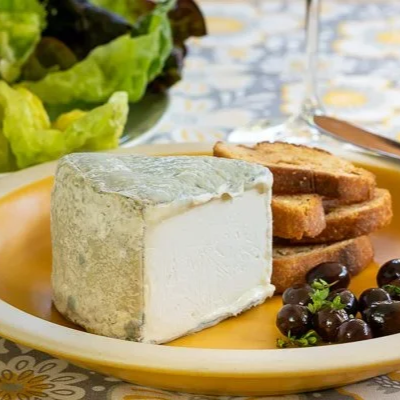
Another Jacquin hit: Tomme de Chèvre Grandmère Adrienne
Bûche de Luçay (say lew-sigh) resembles the more familiar Bucheron, which former cheesemonger Steven Jenkins, in his pioneering Cheese Primer, claimed was one of the first French chèvres to be exported to the U.S. He scorned it, describing it as mass produced and made with frozen curd. I was surprised to learn that Montchevre, a Wisconsin producer with French roots, has a registered trademark for Bucheron, which is now produced in Wisconsin. Perhaps that is why Jacquin has chosen to name its bûche (log) after a nearby village. It is made with fresh goat milk and hand-ladled curd, as you can see in this short video.
Just look at that softening Geotrichum rind and the oozy cream line underneath it. That’s what you want. The specimen in the upper image was quite ripe and the rind was starting to slip; even so, the interior wasn’t peppery. My notes call out the mushroom scent, tender rind, light texture and mild non-goaty flavor.
“It’s a shame that the period of most prolific production does not coincide with the period of greatest demand,” wrote famed French cheesemonger Roland Barthélémy in his Cheeses of the World. “You eat far more cheese in winter than when the weather is fine.”
Let’s work on that, folks.
Bûche de Luçay is widely available. Here’s a partial retail list.