
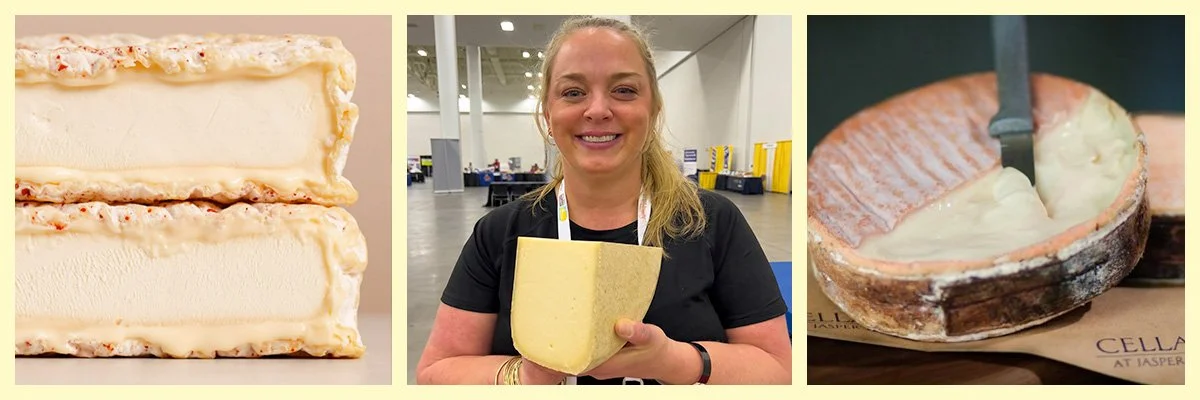
Again?? Yes, unbelievably, again. For the fifth time, a Jasper Hill Farm cheese was deemed Best of Show at the American Cheese Society’s annual judging. What’s more, the winning cheese is a two-time champion, finishing first in 2013 as well. This year, it prevailed over more than 1,600 entries, seducing the judges who elevated it over all the other category winners. “This particular batch was one of the best cheeses I’ve ever eaten in my life,” said the creamery owner after the awards ceremony in Louisville last week. Finishing right behind it was a new Wisconsin sheep cheese and, in third place, an aged Gouda produced at an unusual urban creamery.
The washed-rind Winnimere (above right) is a long-time Jasper Hill favorite, affectionately referred to as “Winnie” at the Vermont creamery. Made with raw cow’s milk from the farm’s own herd, it is banded with local spruce bark to keep it from collapsing as it matures. Writing about it in the San Francisco Chronicle after its debut 15 years ago, I praised the oozy, fondue-like interior and described the aroma as “profoundly woodsy, with scents of mushroom, cherries, earth, garlic, ham hock and mustard.”
In my experience, those notes are still accurate, although I didn’t have the chance to taste a wheel from the winning batch. Alas, none of us will get to take home any Winnimere anytime soon. It is a seasonal cheese, made only in winter. The year’s final make yielded the wheels submitted for judging, and that batch is history. If you’re disappointed (as I am), imagine how it feels to be the Best of Show cheesemaker and have no cheese to sell.
Competing at ACS for the first time, Artze (above left) took second place over all. It is a soft-ripened sheep cheese from Wisconsin’s six-year-old Blakesville Creamery, already an award magnet. Cheesemaker Veronica Pedraza dusts the outside of the 2-pound wheel with piment d’Espelette, a nod to her Basque grandmother, whose family name, Artze, means shepherd. The cheese is luscious when ripe, with a tender Geotrichum rind, notes of mushroom and cultured milk, and a fruity paprika finish. Pedraza purchases her milk from the groundbreaking Wisconsin dairy farm building a flock of prized Assaf sheep. Find Artze online at Murray’s.
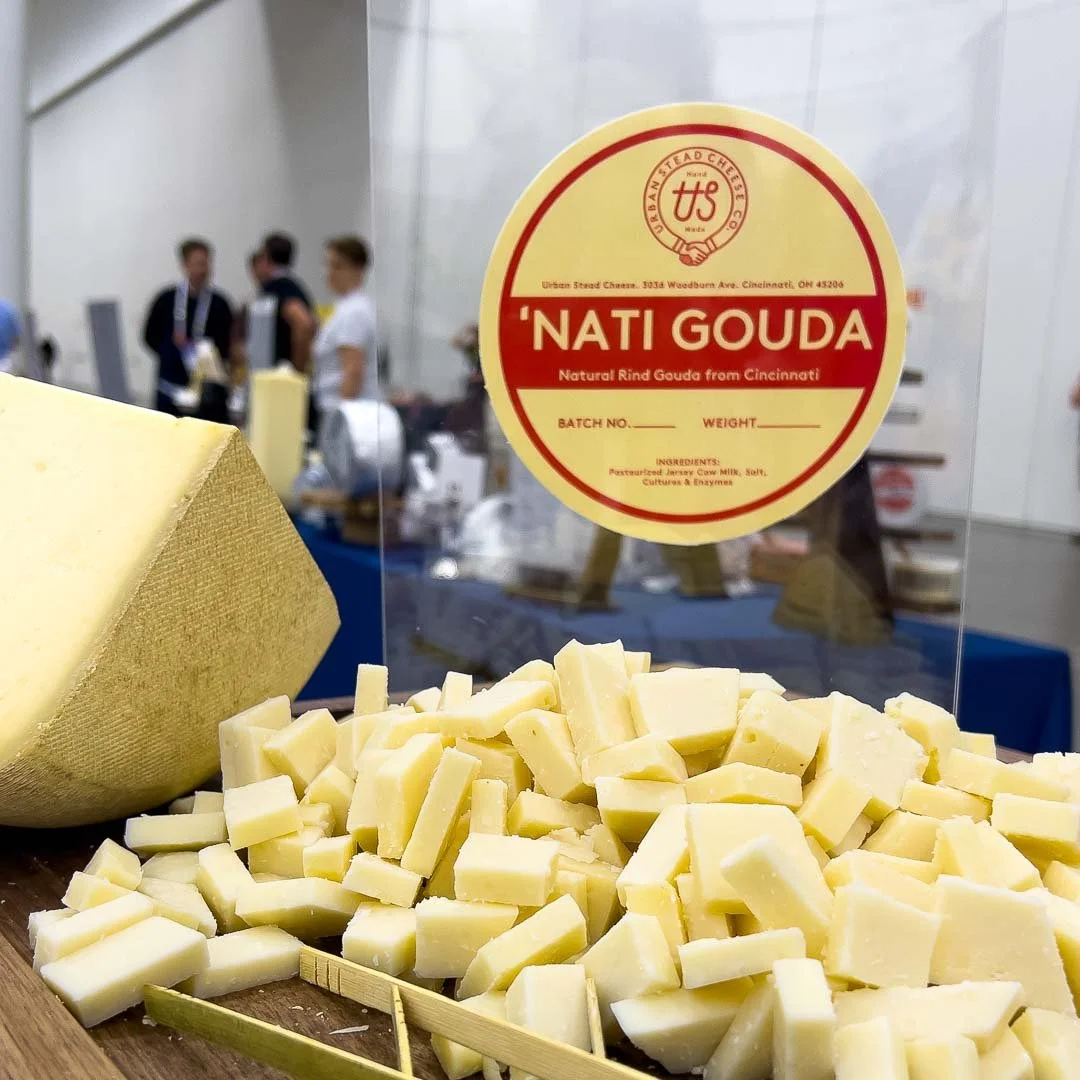
Cincinnati celebrity: Urban Stead Gouda
In third place is a new-to-me cheese from an 8-year-old Cincinnati creamery. Urban Stead’s ‘Nati Gouda is a rare thing—an 18- to 20-month-old Gouda with an unwaxed natural rind. The vast majority of aged Gouda is waxed to prevent mold growth and moisture loss. (Moisture is money.) But a natural rind encourages air exchange and potential flavor development.
“Truth be told, we struggled a lot with our Gouda and came ‘this close’ to scrapping it,” said creamery co-owner Andrea Siefring-Robbins (above center) at a media briefing. “Goodness, am I glad we didn’t.” Me, too. The wheel I tasted was dense, creamy and concentrated, with sweet, milky and nutty flavors.
You can find the full list of 2026 winners here but suffice it to say that Vermont ran the table. Jasper Hill Farm is cementing its reputation as an artisan cheese-industry icon with its five Best of Show ribbons (two for Winnimere and one each for Cabot Clothbound, Harbison and Whitney). Mateo Kehler, who started the enterprise with his brother, Andy, is an exceedingly articulate and thoughtful ambassador for artisan cheese so I’m just going to turn the mic over to him for some final, lightly edited words from the media briefing.
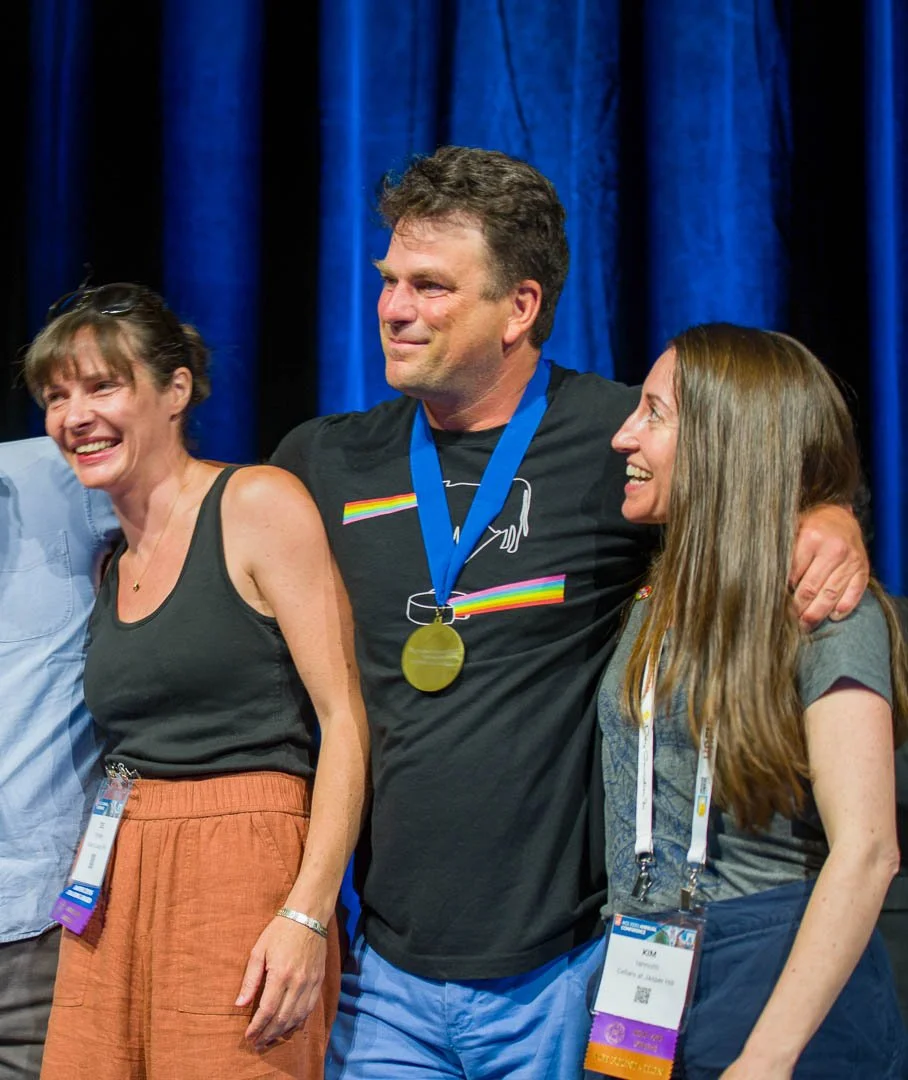
Winner’s circle regular: Mateo Kehler
“We’re using cheese as a mechanism to renew vitality in our community,” said Kehler, who described Greensboro, Jasper Hill’s home base, as “the geographic center of the middle of nowhere.”
Vermont’s dramatic collapse of dairy farms continues, said Kehler, and with that, “the fabric of the rural economy is falling apart.” Agricultural policies designed to combat food inflation do so at the expense of rural communities, said the cheesemaker, transferring wealth from farms to cities. With cheese, he’s fighting back.
“Cheese has the capacity to sustain working lands and make life viable for another generation,” he continued. “And for cheesemakers, it’s an opportunity to participate in the transformation of a sacred raw material, to remember what it means to be human and in contact with an ancient craft—to feed people and be fed by the feeding of others.”
